
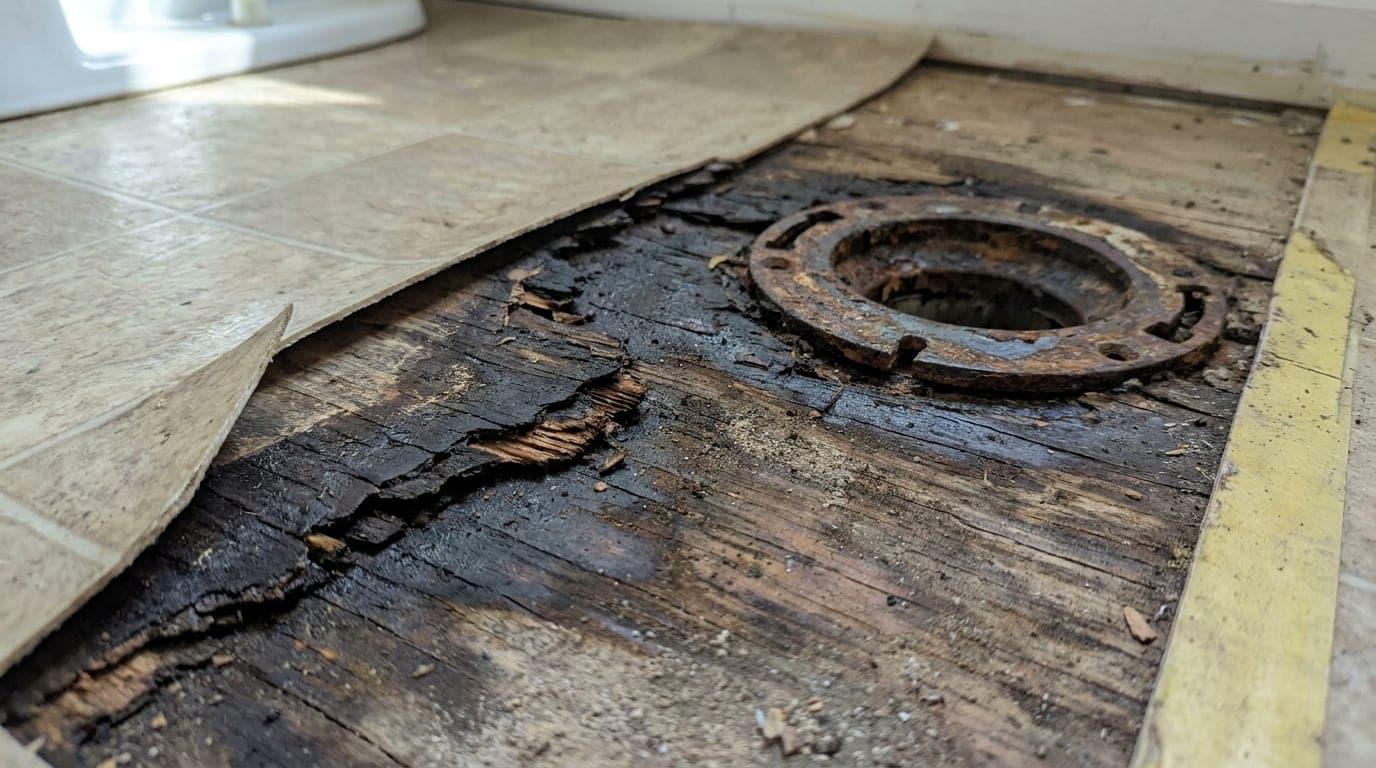
How to Tell If Your Bathroom Subfloor Is Rotten
This is the single most common thing we find when a bathroom comes apart, and the single most common thing left off a cheap quote. You can get a good idea yourself before anyone gives you a number.
Do these in the bathroom you are worried about. Ten minutes, no tools.
1. Stand next to the toilet and rock your weight
Put a foot either side of the toilet base and shift your weight side to side. Any movement, flex or creak from the floor itself is a problem. A toilet should feel like it is bolted to concrete.
If the toilet itself rocks but the floor does not, that may just be loose closet bolts or a failed wax ring. That is cheaper, but fix it now, because that is exactly how the floor underneath starts rotting.
2. Press along the front of the tub
Kneel down and press hard along the floor where it meets the tub apron. Water runs off a shower curtain and lands right there for twenty years. Softness, sponginess or a slight give means the sheathing under the finish floor has been wet.
3. Look at the grout lines in one area only
Cracked grout everywhere is usually age. Cracked grout in one patch, or a single tile that has come loose while its neighbours are solid, is movement, and movement means the substrate under it is no longer stiff.
Same for a tile that sounds hollow when you tap it with a knuckle while the ones around it sound solid.
4. Check the ceiling in the room below
If there is a room under this bathroom, look at its ceiling, especially near the corner closest to the tub or the toilet. Staining, a faint ring, a nail head that has rusted through the paint, or a patch someone has already painted over all point at water that has been coming through for a while.
A repaired ceiling patch under a bathroom is worth asking the previous owner about.
5. Smell the vanity cabinet
Open the vanity, put your head in, and smell it. A musty, earthy smell with nothing visibly wrong means moisture is present somewhere you cannot see. Then run your hand over the cabinet bottom: soft, swollen or crumbling particleboard tells you how long it has been going on.
6. Look at the base of the door casing
Trim wicks water upward. If the bottom inch or two of the door casing or the baseboard nearest the tub is swollen, discoloured or flaking paint while the rest is fine, the floor has been wet.
What it means if several of these fail
It means the floor has to come up, and that is not a bad outcome. It is a known one. Rot found before tile goes down is a line item on an estimate. Rot found after is the reason a job blows its schedule and its budget, and the reason a beautiful new bathroom fails again in five years.
What it does not mean is that your whole floor structure is gone. Most of what we replace is subfloor sheathing, sometimes a joist section near the wet wall. Very rarely is it more than that.
What to do with this before you get quotes
Tell every contractor what you found, and ask each one directly how their estimate handles subfloor repair: is it included, excluded, or an allowance? You will learn a lot from the three answers.
A quote that does not mention it at all in a bathroom showing two or three of these signs is not cheaper. It is just less finished.
We check for this during the estimate and price it as a line item rather than finding it in week two. The whole sequence is in what a bathroom renovation actually involves.
Call (484) 944-6441 and we will come and look at it.