
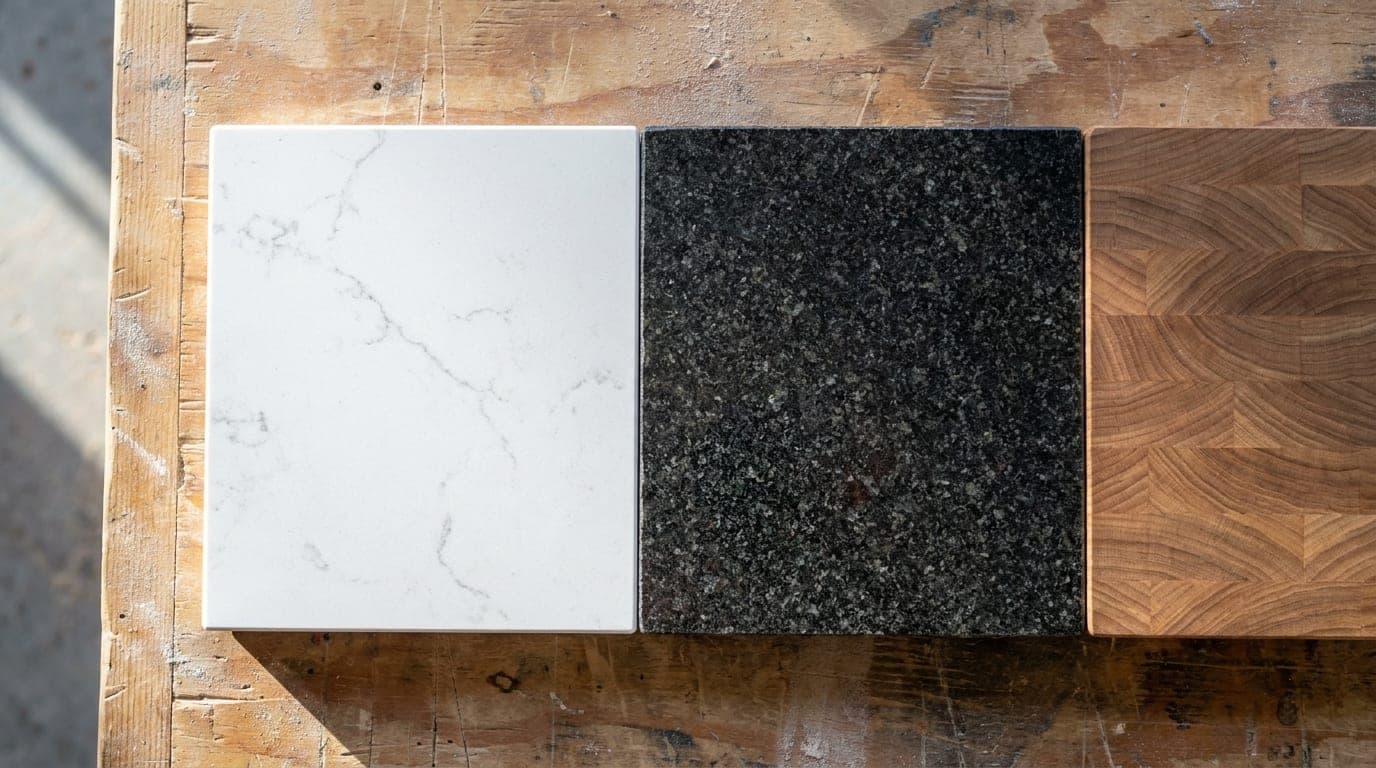
Quartz, Granite or Butcher Block: Picking a Countertop You Will Still Like in Ten Years
Showrooms are good at making every slab look great under perfect lighting. They are less good at telling you what the material is like on a Tuesday night with a pot boiling over. Here is the practical version.
Quartz
Engineered from crushed stone and resin. Non-porous, so it never needs sealing and does not stain from wine, oil or coffee.
Living with it: the most forgiving of the three. Wipe it and move on. Patterns are consistent, so what you see in the sample is what shows up in your kitchen.
Watch out for: heat. Resin scorches. A pan straight off the burner can leave a mark that does not come out. Use a trivet, every time. Also, direct sun through a south-facing window can yellow some quartz over years, so it is a poor choice for a sunroom counter.
Pick it if: you want the least maintenance and you want to know exactly what the finished counter will look like.
Granite
Natural stone, cut from a quarried block. Every slab is different, which is either the appeal or the problem depending on your temperament.
Living with it: durable and genuinely heat-resistant. You can set a hot pan on granite. It is porous, so it needs sealing, typically once a year, which is a ten minute job with a bottle from the hardware store.
Watch out for: the variation. You must go see and approve your actual slab, not a four-inch sample. The pattern in your kitchen will be the pattern in that specific block. Also, unsealed granite will stain from oil.
Pick it if: you want real stone, you like that no two kitchens are the same, and an annual reseal does not bother you.
Butcher block
Solid wood, usually maple, oak or walnut, laminated into a slab.
Living with it: warm in a way stone is not, and by far the cheapest of the three. Its best trait is that it is repairable. Scratches, burns and gouges sand out. Try that with quartz.
Watch out for: water. Standing water at the sink is what kills butcher block. It needs oiling every month or two at first, then a few times a year. Around an undermount sink it needs real diligence, and many people are not diligent.
Pick it if: you want warmth and a lower price and you are honest with yourself about maintenance. A good compromise is butcher block on an island and quartz around the sink and range.
The one that gets skipped
Solid surface, such as Corian. Not stone, not wood, seamless, repairable with sanding, and less expensive than quartz. It scratches more easily and has less of a premium feel, but it is a legitimate option that showrooms tend to push past.
Practical notes on any material
- Template after the cabinets are set. Templating from a drawing produces gaps. Wait until the boxes are in and level.
- Talk about seam placement before fabrication. Seams should land somewhere logical, not in the middle of the run in front of the window.
- Decide on the sink first. Undermount versus drop-in changes the cutout and the edge detail.
- Overhangs need support. More than about ten inches unsupported wants brackets or a corbel, whatever the salesperson tells you.
Not sure which fits your kitchen and how you cook? Call (484) 944-6441 and we will talk through it.